

What Value for Money Means for Your Catered Event
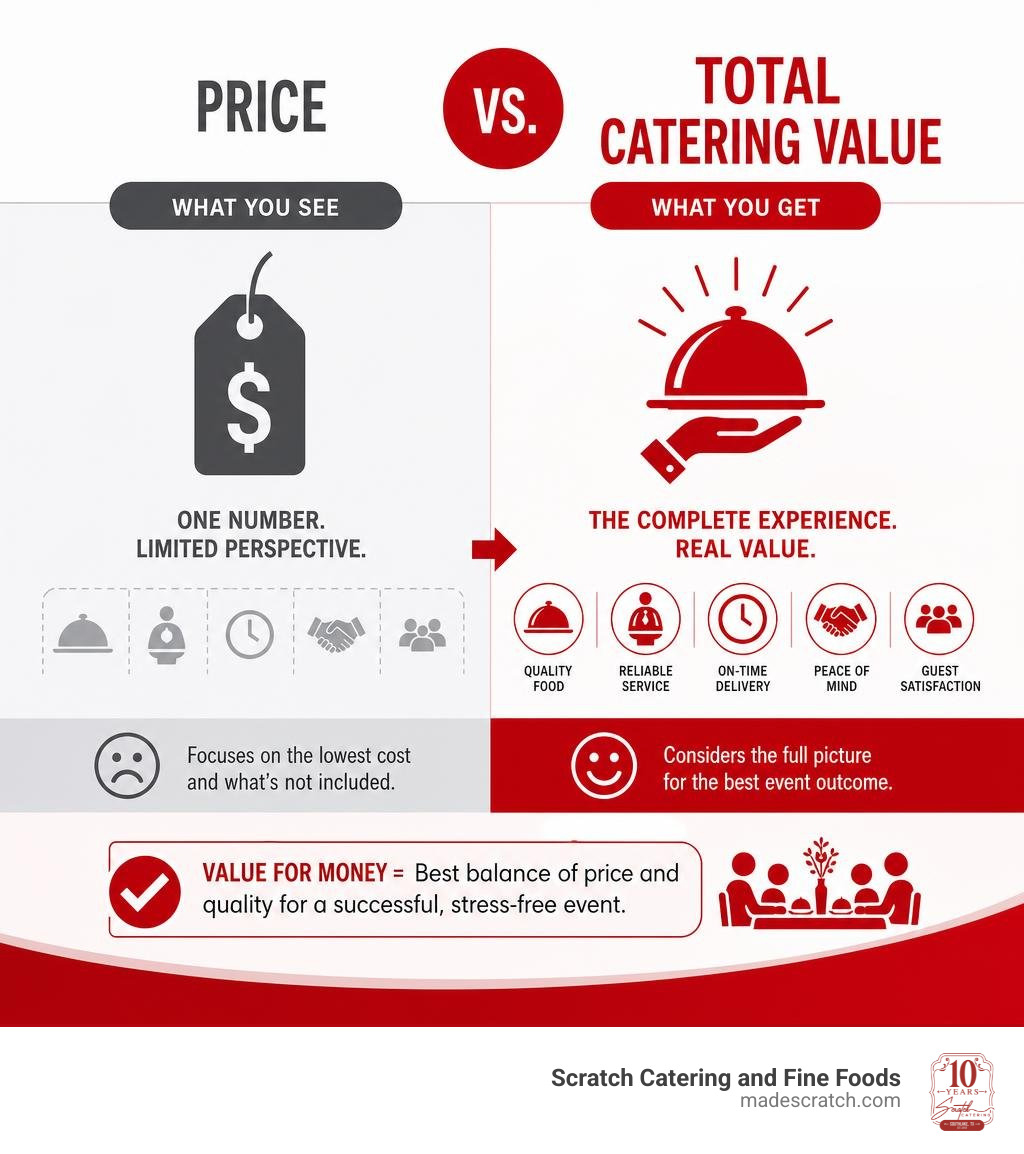
Value for money in catering means choosing the option that delivers the best overall result for your event – not simply the lowest quote. It weighs price alongside food quality, portion reliability, presentation, service, convenience, and the risk of things going wrong.
For a busy planner, the quick test is simple:
| Consider | Ask |
|---|---|
| Total cost | What is included beyond the food itself? |
| Quality | Will the menu, portions, and presentation suit the occasion? |
| Service | Does the provider reduce work and stress for the host? |
| Reliability | Can they deliver on time and handle the event smoothly? |
| Guest experience | Will attendees feel well cared for and impressed? |
Public procurement bodies use a similar idea: value comes from the best balance of whole-life cost and quality, rather than the cheapest upfront option. For catering, that means comparing the complete event outcome, not just a line-item price.
Scratch Catering and Fine Foods helps hosts look beyond price so they can make a clear, confident choice for the people around their table. I am Ted Bilsky, and the next sections break down the terms that make value easier to compare.
Relevant articles related to value for money:
Official Definition and Principles of Value for Money
When government institutions, audit offices, and corporate procurement directors define value for money, they do not start by asking who is selling at the lowest price tag. Across formal procurement frameworks—from the UK National Audit Office to local government standards—the phrase has a strict, technical definition: the optimal combination of whole-life costs and quality to meet the user’s explicit requirements.
In economics, as explored in formal literature on Value (economics), economic value is fundamentally a measure of the total benefit provided to a consumer or organization. Price, on the other hand, is merely the monetary figure required to initiate a transaction. When you purchase a service, value for money represents a comprehensive assessment of whether your financial resources are working as efficiently and effectively as possible to deliver a specific, desired outcome.
At Scratch Catering and Fine Foods, we apply these rigorous institutional standards to party planning and corporate event dining across the Dallas-Fort Worth metroplex. When evaluating options, buyers often overlook the distinction between initial purchase price and total end-to-end investment. Initial price is simply the invoice total sent before an event begins. Whole-life cost (or full lifecycle cost) incorporates setup, service labor, rentals, equipment handling, waste management, and the potential hidden labor burden placed back onto your team or family.
To properly gauge value, purchasing standards require that goods or services satisfy the concept of “fitness for purpose.” A bottom-tier bid that fails to keep hot appetizers at temperature or leaves half your guests searching for second helpings is not fit for purpose—rendering any initial savings completely illusory. To explore these fundamentals in depth, review our catering service complete guide.
Defining Value for Money in Public vs Private Sectors
While the underlying goal of optimizing expenditures remains constant, public sector agencies and private businesses evaluate value for money through slightly different operational lenses.
In the public sector, procurement officers operate under strict regulatory standards, such as those outlined by statutory authorities like the Value for money | Department of Finance. Public sector decision-makers must justify spending taxpayer funds with utmost transparency, taking into account statutory compliance, broad economic impact, risk mitigation, and socio-environmental responsibility. Public audits measure whether public funds achieved maximum social utility without wasteful expenditure.
In the private sector—and specifically in commercial hospitality and private events—the equation focuses on customer utility, brand reputation, and operational execution. Private buyers evaluate value for money based on how effectively a partner alleviates organizational stress, enhances guest satisfaction, and reflects positively on the host.
| Dimension | Public Sector Procurement | Private & Corporate Event Catering |
|---|---|---|
| Primary Focus | Statutory compliance, transparency, public utility | Guest experience, host convenience, brand impact |
| Cost Evaluation | Formal Public Sector Comparator (PSC) & whole-life analysis | Direct budget alignment vs total service inclusions |
| Risk Appetite | Low; strictly standardized risk-transfer models | Proactive risk elimination (e.g., seamless timing, menu dietary coverage) |
| Non-Financial Focus | Broader economic benefit, social equity, policy alignment | Culinary quality, presentation, guest sentiment, hospitality |
Whether organizing a high-profile corporate gala in downtown Fort Worth or an intimate family celebration in Southlake, private decision-makers benefit from adopting the public sector’s rigorous holistic mindset: calculating true overall return rather than taking short-term shortcuts.
Why Lowest Price Does Not Equal Value
Focusing exclusively on the lowest line-item quote is one of the most frequent traps in event planning. A suspiciously low estimate usually indicates that cost has been stripped out of essential operational areas: ingredients, staffing ratios, food safety controls, or professional logistics.
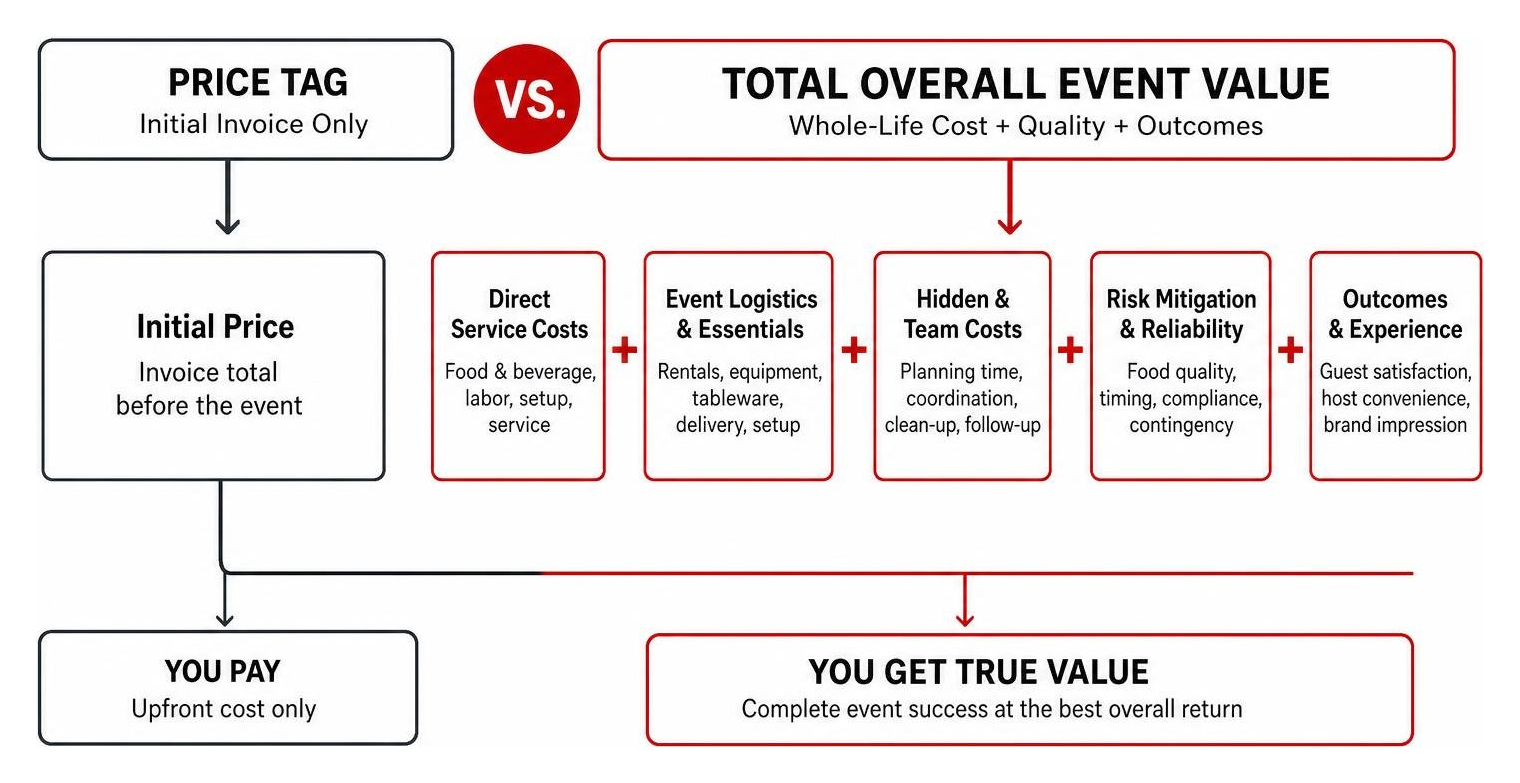
When an event service trims costs to the bone, the host invariably absorbs the difference in hidden expenses or operational failure:
- Inadequate Staffing: Lower quotes often mean fewer servers or bartenders on site, leading to long guest lines, delayed meal service, and cold food.
- Under-portioned Menus: Budget-driven caterers may skimp on portion sizes, leaving guests unsatisfied and forcing hosts to buy last-minute supplemental food.
- Hidden Service Add-ons: Bids that appear cheap upfront frequently exclude baseline items like warming chafers, serving utensils, high-grade disposable tableware, delivery fees, or setup labor.
- Liability and Safety Risks: Low-cost operations may cut corners on commercial licensing, kitchen sanitization, or liability insurance, exposing hosts to severe operational liabilities.
Choosing a caterer purely on base price often creates a “false economy”—a choice that appears economical initially but ultimately costs significantly more in stress, supplementary spending, and compromised guest experiences. For a detailed look at breaking down hidden fees, read our guide on budget bites unpacking catering costs for your next event.
The Core Framework: Evaluating Economy, Efficiency, and Effectiveness

To remove guesswork from purchasing decisions, public auditors and institutional procurement leaders rely on a structured analytical tool known as the “Three Es” framework: Economy, Efficiency, and Effectiveness.
When applied systematically, this framework allows event hosts in Plano, Frisco, and across DFW to measure whether every dollar spent yields genuine quality and performance.
The Three Es Framework and Equity
The classic framework organizes evaluation into three interconnected pillars, with leading institutions adding a fourth dimension—Equity:
- Economy (Spending Less): Minimizing the cost of resources used for an activity while maintaining the required level of quality. In catering, economy means procuring premium ingredients and professional staffing efficiently through smart sourcing without compromising standards.
- Efficiency (Spending Well): Maximizing output relative to input. It asks: How effectively are resources translated into delivered service? A highly efficient catering operation uses streamlined prep workflows, expert kitchen organization, and trained staff to execute flawless service without wasted time or discarded food.
- Effectiveness (Spending Wisely): The extent to which the service achieves its intended outcomes. For your event, effectiveness measures whether the food was delicious, served at proper temperatures, beautifully presented, and highly praised by attendees.
- Equity (Spending Fairly): Ensuring benefits are distributed equitably among all participants. In event hospitality, equity means accommodating dietary requirements (vegan, gluten-free, nut allergies) with equal care and culinary creativity, ensuring every guest enjoys an exceptional dining experience.
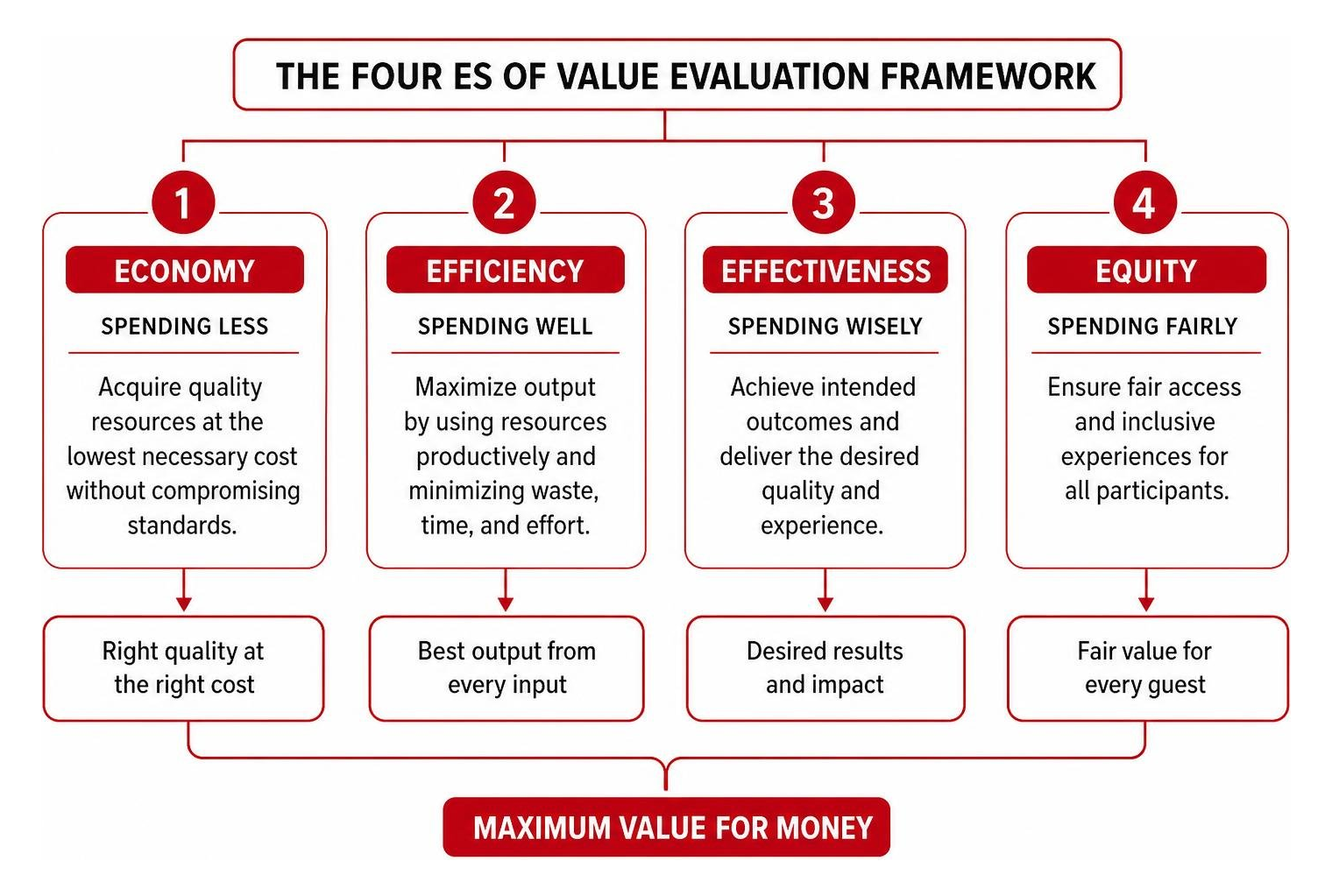
By balancing all four Es, hosts ensure their menu is not only cost-conscious (Economy) and smoothly run (Efficiency), but also memorable (Effectiveness) and inclusive (Equity).
Measuring Value for Money Across the Full Lifecycle
Evaluating value for money is not a static calculation made before signing a contract; it is an ongoing process across the entire project lifecycle:
- Pre-Event Planning Stage: Define precise specifications. Calculate comprehensive estimates that include prep, transport, staffing, equipment rentals, and breakdown services.
- Execution Stage: Monitor operational reliability. Does the team arrive strictly on time? Is setup executed quietly and professionally? Are hot items held at optimal temperatures?
- Post-Event Analysis Stage: Review total outcomes against total outlay. Assess guest feedback, evaluate leftovers or waste, and review invoice accuracy.
At Scratch Catering and Fine Foods, led by award-winning chef Teddy B., our culinary team designs menus specifically to maximize full lifecycle value. From scratch-made dishes that hold heat and flavor perfectly during transport to complete turnkey setups, we eliminate post-event surprises. For actionable advice on organizing event scope and headcount costs, consult our guide on the price of a party budgeting for 50 guests.
Beyond Cost: Non-Financial Factors in Service Procurement

When auditing value in service contracts, money is only half of the equation. Non-financial parameters heavily influence the final outcome of any catered gathering in Grapevine, Arlington, or McKinney.
Evaluating non-price criteria protects hosts against unpleasant surprises and guarantees that the event environment aligns with their personal or brand standards.
Quality, Sustainability, and Risk Management
To build an accurate assessment of total value, planners must integrate three critical non-financial dimensions:
- Quality and Fitness for Purpose: Culinary standards cannot be accurately captured on a spreadsheet. Quality encompasses flavor balance, visual presentation, ingredient fresh-sourcing, menu diversity, and temperature stability. High quality guarantees that food tastes as good as it looks.
- Sustainability and Sourcing: Modern hosts value ethical supply chains. Utilizing locally sourced ingredients, reducing food waste through accurate portioning, and utilizing eco-friendly packaging enhance environmental sustainability while delivering superior taste.
- Risk Management and Reliability: Food safety, timing, and contingency handling represent massive non-financial factors. A reputable catering firm brings commercial-grade kitchen licenses, comprehensive liability coverage, backup equipment, and experienced managers who resolve unexpected venue challenges seamlessly.
| Evaluation Metric | Low-Cost Quote Option | Full-Service Value Option (Scratch Catering and Fine Foods) |
|---|---|---|
| Ingredient Sourcing | Mass-produced, pre-packaged, frozen commodities | Freshly prepared scratch recipes by Chef Teddy B. |
| Portion Reliability | Strict minimal limits; risk of shortages | Generous, expert portions based on guest demographics |
| Service Inclusions | Delivery drop-off only; client manages setup & heating | Turnkey setup, chafing dishes, serving utensils, seamless timing |
| Dietary Accommodation | Basic exclusions or limited menu substitutes | Handcrafted options catering to all dietary needs |
| Risk Mitigation | Unverified coverage; host absorbs operational delays | Fully insured, licensed, dedicated logistics management |
Choosing full-service quality eliminates operational friction, keeping hosts focused on engaging their guests rather than managing kitchen emergencies.
Key Best Practices and Common Misconceptions in Purchasing
Achieving true value for money requires structured decision-making. Professional buyers use clear, repeatable procurement principles to evaluate quotes and avoid common pitfalls.
Key Principles for Evaluating Event and Service Proposals
When reviewing proposals for corporate events, weddings, or private holiday celebrations, implement these proven best practices:
- Establish Clear, Unambiguous Specifications: Define your exact expectations before requesting proposals. Specify headcount, service style (buffet, plated, or family-style), dietary constraints, and necessary equipment inclusions.
- Require Itemized Proposals: Demand transparent quotes that break down food costs, labor hours, delivery charges, equipment rentals, service fees, and taxes. Transparent pricing prevents unexpected final invoice inflation.
- Conduct Competitive Benchmarking: Compare multiple bids across equivalent criteria. Never evaluate a drop-off catering bid against a full-service setup without adjusting for labor and equipment differentials.
- Review Verifiable References and Track Records: Examine past performance, client testimonials, and food safety records. Consistent execution over time is the strongest indicator of future reliability.
For an extensive step-by-step checklist tailored for major events, refer to our ultimate checklist for comparing dallas wedding caterers.
Common Mistakes When Assessing Overall Value
Even experienced planners occasionally fall prey to common purchasing misconceptions. Be aware of these key mistakes:
- The Single-Metric Trap: Focusing exclusively on per-person food cost while ignoring service, delivery, and setup fees.
- Ignoring the Cost of Internal Labor: Assuming DIY setup saves money. When hosts or staff spend hours setting up steam trays, warming dishes, and clearing tables, internal labor costs and stress skyrocket.
- The “False Economy” of Over-Ordering Cheap Food: Buying mass quantities of low-quality food results in heavy waste and unimpressed guests. Higher-quality, well-portioned scratch meals generate far higher guest satisfaction.
- Short-Term Purchasing vs Long-Term Partnering: Treating caterers as one-off vendors rather than building ongoing relationships. Partnering with a trusted team like Scratch Catering and Fine Foods streamlines future event planning and guarantees consistent quality.
Frequently Asked Questions About Value for Money
What is the official definition of value for money?
The official definition used by government procurement bodies, national audit offices, and corporate financial managers is the optimal combination of whole-life costs and quality (or fitness for purpose) to satisfy specified user requirements. It is explicitly not defined as simply securing the lowest purchase price.
How do you measure value for money in catering services?
Measuring value in catering requires assessing total service costs against food quality, menu diversity, portion accuracy, setup reliability, and host convenience. True value is achieved when an event runs smoothly, guests are satisfied, dietary needs are met, and all necessary equipment and labor are transparently included without unexpected fees. To explore tailored menu ideas that optimize your spend, view our resource on wedding menu ideas for every budget.
What are the 4 Es of value evaluation?
The 4 Es of value evaluation are:
- Economy: Acquiring resources at the best possible cost for the required quality (spending less).
- Efficiency: Maximizing output relative to input through streamlined operations (spending well).
- Effectiveness: Successfully achieving desired outcomes and host objectives (spending wisely).
- Equity: Ensuring benefits and accommodations are distributed fairly among all participants (spending fairly).
Conclusion
Understanding value for money empowers event hosts to move past deceptive price tags and evaluate what truly matters: exceptional food, flawless execution, and a memorable guest experience. When you balance initial outlay against full lifecycle inclusions, culinary quality, and operational reliability, the best choice becomes remarkably clear.
At Scratch Catering and Fine Foods, our passion is turning every gathering into an extraordinary dining experience across Southlake, Dallas, Fort Worth, Plano, Frisco, McKinney, Arlington, and Grapevine. Under the guidance of award-winning chef Teddy B., our culinary team crafts gourmet menu offerings made from scratch with fresh ingredients, delivered ready to serve or effortlessly reheated.
Whether planning an intimate family holiday dinner, an executive corporate retreat, or looking for premier DFW wedding catering services, we deliver the optimum combination of culinary excellence, hospitality, and overall value. Let us handle the details so you can enjoy your event around the table with confidence. Contact Scratch Catering and Fine Foods today to begin planning your custom event menu!

